 21 May 2004
Historic fireboat open for tours this weekend
by Dana Robertson
Photos by Stuart Bayer
A 73-year-old retired New York City fireboat, the John J. Harvey, will dock at various locations on the Hudson River this weekend as part of its fourth annual round-trip voyage from New York City to Troy, N.Y., on the "Blue Links" tour.
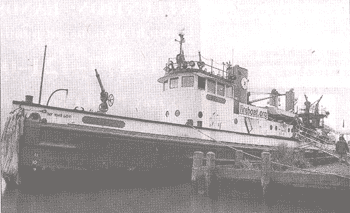
The boat, which assisted firefighting efforts at the World Trade Center on Sept. 11, 2001, is expected to reach Cold Spring about 6 tonight and open for public viewing there at 10 tomorrow morning. The John J. Harvey left Manhattan on Aug. 11 and reached its northernmost destination of Troy on Aug. 16. The return trip brings the boat to Cold Spring, Stony Point, Piermont and Yonkers.
The aim of the tour is to compile a comprehensive list of needed improvements to docks, cleats, bollards and fendering systems on the Hudson River that organizers want to be addressed in the upcoming federal transportation bill, a $300 billion spending allowance scheduled to be reauthorized this year.
"Every where up and down the Hudson, towns and rivers are creating new ways to access the river," said Carter Craft, executive director of the Metropolitan Waterfront Alliance, a Manhattan-based group that advocates for sustainable development along the Hudson. "The fireboat is a great way to get out and see how much access already exists."
Fierce competition from highways and other forms of transportation has prevented the Hudson from receiving enough funding in the past, although the river was vital to the development of waterfront towns. Craft described the Hudson as the "first highway." With the advent of railroads and paved highways, though, the river's importance diminished and its waterfront infrastructure faded into obscurity and disrepair.
"I think people are realizing that we need other ways to get around," Craft said. "We've maxed out our bridge crossings, maxed out our highways."
The organizers, the Metropolitan Waterfront Alliance and Save Our Ships New York, are also attempting to raise public awareness of the river's recreational value along with its transportational usefulness.
"If you think of the river as a resource, it can be the open space, it can be the playground, it can be the performing arts and cultural space that people sought in the suburbs," Craft said.
The voyage includes tours of 30 to 60 minutes in and out of town or city docks.
Craft said that past journeys have been fruitful.
"We've seen what was an old oil dock (in Hudson, N.Y.) be converted to a town dock. ... When we started the tour four years ago, it was a rusty piece of metal sticking into the river."
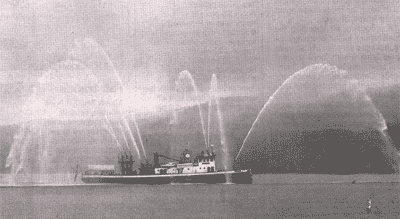 Now, thanks to the efforts of the Metropolitan Waterfront Alliance and the mayor of Hudson, the town has a well-used dock.
The organizers and owners of the John J. Harvey are also hoping to raise public interest in the historical craft itself, which, like the Hudson's docks, could use a bit of restoration.
When the 130-foot, 268-ton boat was built in 1931, she was the largest and most powerful fireboat in the world. Her internal combustion engines replaced steam power on New York's waterways, and her pumps supplied as much water as 20 firetrucks. She set the pattern for all subsequent fireboats and provided the model for modern fireboat engineering.
The craft was retired in 1994 and bought at auction in 1999, saved from the scrapyard by eight marine preservationists. The following year the John J. Harvey was placed on the National Register of Historic Places.
One of the fireboat's most heroic moments was its work on Sept. 11, 2001. For 80 hours after the twin towers fell, several of the boat's owners pumped water to firefighters working in the wreckage. Because all fire hydrants west of the World Trade Center were out of commission, the John J. Harvey, along with two of the city's fireboats, provided much of the water to the firefighters throughout that week. It also helped evacuate some 150 people trapped at the seawall near the Battery.
A recent fund-raising effort has helped to restore the vessel. One of the two propellers is damaged, requiring a lowered traveling speed of about 8 knots. In perfect condition the craft can travel at twice that speed. Though the boat is not dangerous, it rattles when pushed to faster speeds, and doing so could cause more damage.
In May, the state granted $320,000 in matching funds for restoration of the fireboat to Save Our Ships New York, a nonprofit corporation dedicated to the preservation of historic vessels statewide.
Eric Weisler, one of the fireboat's 16 current owners and a Save Our Ships New York trustee, said $200,000 in repairs to the hull and propeller are planned for the fall if the money can be raised in time. He said fund-raising efforts have yielded 20 percent to 25 percent of the necessary funds.
"We are hoping that this 'Blue Links' tour up to Troy and back will spark a lot of interest," Weisler said.
Read original article (if still published)
Read more articles...